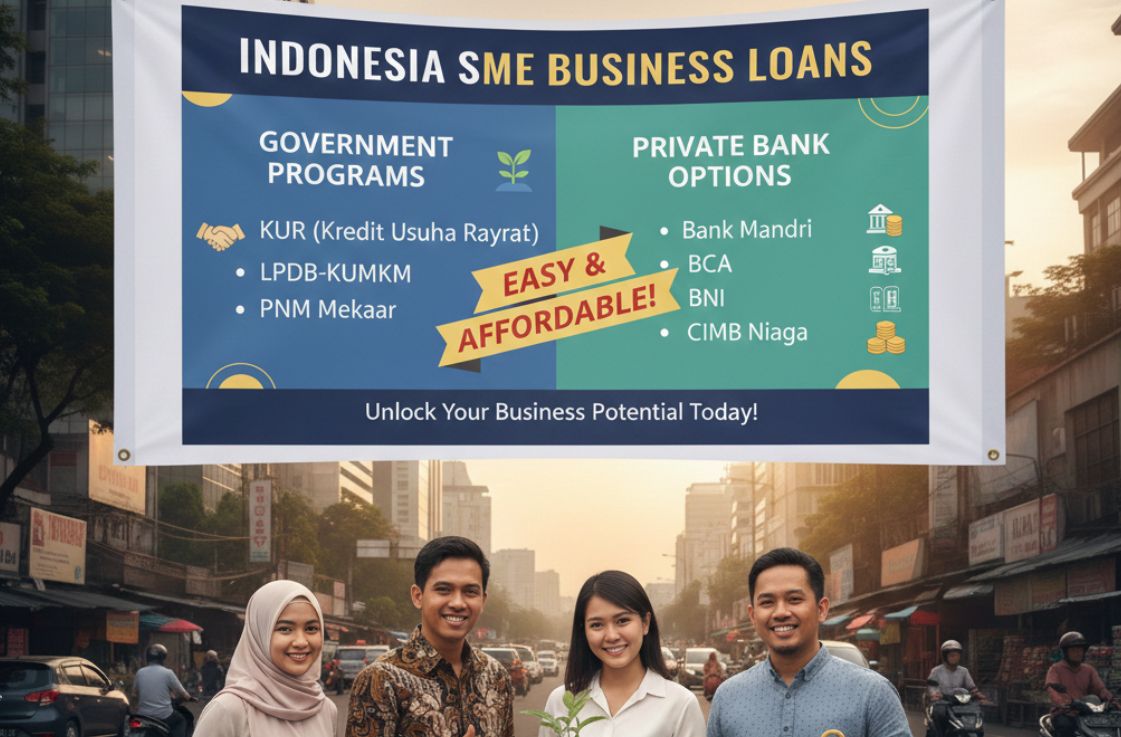
Understanding SME Business Loans in Indonesia
Small and Medium Enterprises (SMEs) are the backbone of Indonesia’s economy. They account for the majority of businesses in the country and play a key role in employment and national economic growth. However, one of the challenges Indonesian SMEs consistently face is access to affordable and reliable financing. Whether for working capital, expansion, or investment in equipment, borrowing options are essential for SMEs to thrive. Thankfully, a combination of government programs and private bank loans aims to support Indonesian entrepreneurs in this journey.
Government-Led Loan Programs for SMEs
Kredit Usaha Rakyat (KUR): The Flagship Support
The Kredit Usaha Rakyat (KUR) program is perhaps the most well-recognized government initiative to assist small businesses. Introduced to improve financing accessibility, KUR offers subsidized loans with lower interest rates compared to market rates. These loans are designed to serve micro, small, and medium enterprises that might otherwise struggle to secure traditional financing from banks. KUR loans can be used for working capital, buying inventories, or investing in business growth, often without requiring heavy collateral depending on the loan amount and scheme.
The government periodically adjusts KUR features, but the core benefits remain affordability and broader access. Businesses operating in various sectors—such as agriculture, trade, and manufacturing—can apply through participating banks that distribute these funds.
UMi Micro-Loan Program
In addition to KUR, the Indonesian government operates the Pembiayaan Ultra Mikro (UMi) program. This initiative is aimed at the smallest, often informal, micro enterprises that may not meet the formal requirements of traditional bank loans. UMi provides small funding packages with simplified eligibility criteria—such as holding a valid ID card—making it easier for grassroots entrepreneurs to take their first step toward formal financing.
Interest Subsidies and Special Assistance
Another important aspect of government support includes interest subsidy schemes that reduce borrowing costs, particularly for smaller loans. Through mechanisms that co-finance portions of interest payments, the government helps alleviate short-term financing burdens for SMEs. These subsidies can apply to a range of loan sizes, depending on prevailing policies, and help improve cash flow for business owners when market conditions are tight.
Recent years have seen additional initiatives where state funds are placed into state banks with explicit instructions that they be used to extend affordable credit to cooperatives and local businesses. These efforts aim to stimulate broader economic activity, especially in rural areas.
Private Bank Loan Options for SMEs
National Banks with SME Loan Products
Alongside government programs, major Indonesian banks offer dedicated SME financing solutions. These products usually provide more flexibility in loan size and terms, although interest rates are typically higher than subsidized government programs.
For example, Bank Negara Indonesia (BNI) has an active role in disbursing SME loans, particularly under the government’s subsidized schemes, while also offering its own credit products tailored to small businesses.
Similarly, other major banks such as Bank Rakyat Indonesia (BRI) and Bank Mandiri provide SME-focused financing, including micro loans and working capital loans with competitive terms. These products are geared toward helping businesses with recurring expenses or those looking to scale operations.
Specialized SME Financing from Commercial Banks
Beyond traditional loans, some commercial banks offer innovative financing solutions targeted at socially impactful or niche industries. For instance, Bank DBS Indonesia has introduced blended finance products that allow SMEs with societal benefits to access funding without extensive collateral requirements. This type of product is particularly attractive for social enterprises or startups with strong community impact.
Flexible SME Loan Structures
Banks like Maybank Indonesia provide a broad range of financing options tailored for growing enterprises. Their SME loans can cover working capital needs, investment loans, and longer-term financing—sometimes up to several hundred billion rupiah depending on the business’s profile. Such products come with competitive interest rates, flexible tenors, and choices of collateral, allowing SMEs to align their financing with long-term goals.
Choosing the Right Loan for Your Business
Selecting the right financing option depends on multiple factors: the purpose of the loan, business size, credit history, and whether the business qualifies for government support. Government programs like KUR and UMi are ideal for new or smaller enterprises seeking low cost access to capital, while private bank loans may suit more established SMEs looking for larger financing amounts or specialized services.
In all cases, potential borrowers should carefully review requirements, interest rates, repayment schedules, and eligibility criteria. Combining government support with private bank expertise can offer a balanced and strategic approach to business lending in Indonesia’s dynamic SME landscape.