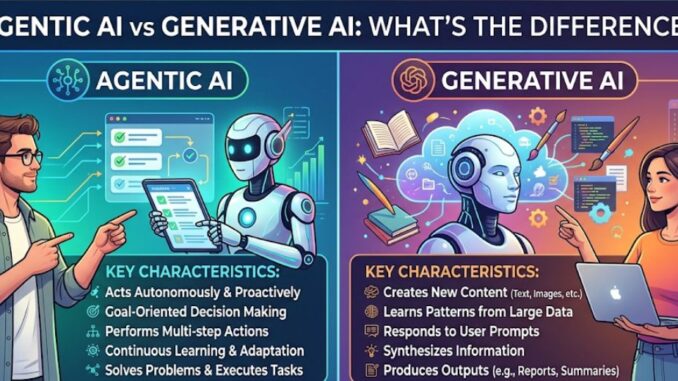
Agentic AI vs Generative AI: What’s the Difference?
Artificial intelligence is moving beyond simple chatbots and content-generation tools. Two terms that are becoming increasingly important in the AI landscape are Generative AI and Agentic AI. Although they are closely related, they serve different purposes. Generative AI focuses mainly on creating content, while Agentic AI is designed to take action, make decisions, and complete tasks with greater independence. Understanding the difference can help businesses and everyday users choose the right technology for their needs.
What Is Generative AI?
Generative AI refers to artificial intelligence systems that can create new content based on instructions or prompts. These systems learn patterns from large amounts of data and use that knowledge to generate text, images, audio, video, software code, and other forms of content.
AI writing assistants, image generators, coding assistants, and conversational AI platforms are common examples of Generative AI. A user provides a prompt, and the system produces a response based on that request. For example, someone could ask a Generative AI tool to write a blog article, create a product description, summarize a document, or generate programming code.
The main strength of Generative AI is its ability to produce useful content quickly. However, it generally waits for instructions and responds to them rather than independently managing a complete objective.
What Is Agentic AI?
Agentic AI takes the concept of artificial intelligence a step further. Instead of simply responding to a prompt, an AI agent can be designed to pursue a specific goal, plan multiple steps, use available tools, evaluate results, and adjust its actions when necessary.
For example, imagine a company wants to monitor customer support requests. A traditional Generative AI system could draft responses to individual questions. An Agentic AI system could potentially identify incoming requests, determine their priority, search relevant company information, prepare an appropriate response, update another system, and escalate complicated cases to a human when necessary.
The defining characteristic of Agentic AI is therefore not just content generation. It is the ability to operate through a sequence of actions toward a desired outcome.
The Key Difference Between Agentic AI and Generative AI
The simplest way to understand the difference is to think about their roles. Generative AI is primarily a creator, while Agentic AI is more like a task-oriented operator.
Generative AI typically receives an instruction and generates an output. Agentic AI can receive a broader objective and determine the steps needed to accomplish it. An agent may use a Generative AI model as its reasoning or content-generation component, but it can also interact with tools, databases, applications, and external systems.
This means Agentic AI can be more suitable for workflows that involve several connected tasks. Generative AI remains highly useful when the main requirement is creating or transforming information.
How Businesses Can Use Both Technologies
Businesses do not necessarily have to choose between Agentic AI and Generative AI. In many cases, the two technologies can work together.
A company might use Generative AI to produce marketing copy, analyze documents, or answer employee questions. Agentic AI could then coordinate larger workflows involving those capabilities. For example, an AI agent could collect information from multiple sources, ask a Generative AI model to summarize it, check the result against predefined requirements, and prepare the final output for human review.
This combination can make AI systems more useful for automation while still keeping humans involved in important decisions.
Which Technology Is Better?
Neither technology is universally better because they solve different problems. Generative AI is an excellent choice when the goal is to create content, brainstorm ideas, summarize information, translate text, or assist with coding.
Agentic AI becomes more valuable when the task requires planning, tool usage, decision-making, and multiple actions. It can potentially reduce repetitive manual work by coordinating an entire process rather than assisting with only one step.
The Future of AI
The distinction between Generative AI and Agentic AI will likely become increasingly important as artificial intelligence becomes integrated into business software and everyday applications. Future AI systems may combine powerful content-generation models with planning, memory, tool access, and autonomous task execution.
Generative AI has already changed how people create and interact with information. Agentic AI could represent the next stage by changing how software performs work. Rather than simply giving users answers, AI systems may increasingly help accomplish complete objectives from beginning to end.
Ultimately, Generative AI is primarily about creating, while Agentic AI is about acting toward a goal. Both technologies have significant potential, and understanding their differences is essential for making informed decisions as the AI ecosystem continues to evolve.
Leave a Reply