Introduction to MSME Financing in India
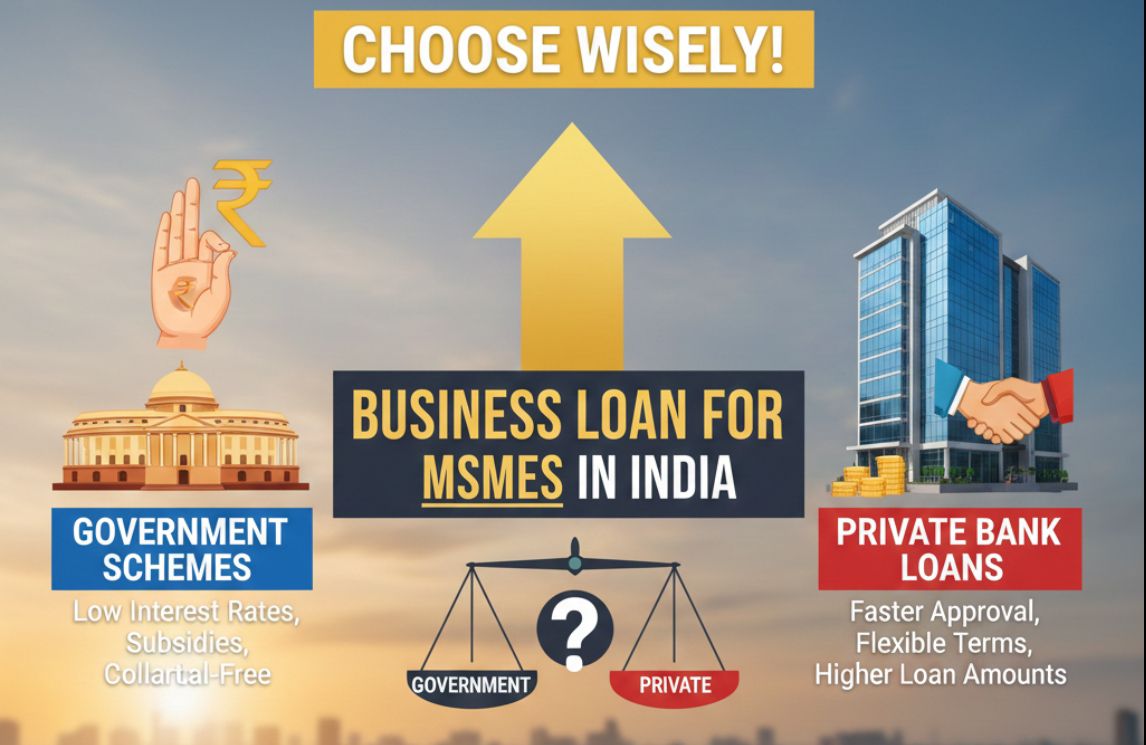
Micro, Small, and Medium Enterprises play a crucial role in India’s economic development by generating employment and supporting innovation across sectors. Despite their importance, access to timely and affordable finance remains one of the biggest challenges for MSMEs. Business loans help bridge this gap by providing funds for working capital, expansion, machinery purchase, and day-to-day operations. In India, MSMEs generally rely on two major sources of formal funding: government-backed loan schemes and private bank loans. Understanding how these two options differ is essential for making the right financial decision.
Government Business Loan Schemes for MSMEs
Government loan schemes are designed with the primary objective of promoting entrepreneurship and strengthening small businesses. These schemes focus on improving credit access for MSMEs that may lack collateral or an extensive credit history. Programs supported by the government often involve interest subsidies, credit guarantees, and relaxed eligibility norms, making them especially beneficial for startups and small enterprises in their early stages.
One of the key advantages of government schemes is affordability. Interest rates are usually lower than market-linked loans, and repayment tenures are more flexible. The reduced requirement for collateral also lowers entry barriers for first-time business owners. However, the application process can sometimes be time-consuming due to documentation checks and approval procedures involving multiple institutions.
Private Bank Loans for MSMEs
Private banks offer business loans based on commercial lending principles. These loans are assessed primarily on the financial strength, credit score, business stability, and repayment capacity of the borrower. For MSMEs with consistent revenue, proper financial records, and a good credit profile, private bank loans can be a fast and efficient funding option.
A major advantage of private bank loans is speed and flexibility. Many banks provide digital loan applications, quicker approvals, and customized loan products tailored to specific business needs. Loan amounts can also be higher compared to government schemes. However, this convenience often comes at a higher cost, as interest rates are market-driven and collateral requirements are usually stricter.
Interest Rates and Cost Comparison
The cost of borrowing is a critical factor for any MSME. Government schemes generally offer lower interest rates or indirect benefits such as guarantees that reduce lender risk. This makes them more suitable for small businesses aiming to minimize financial pressure. Private bank loans, while faster and more flexible, may involve higher interest rates and additional charges, especially for businesses with moderate credit profiles.
Accessibility and Suitability for MSMEs
Government schemes are ideal for micro and small enterprises, startups, and businesses operating in priority sectors. However, limited awareness and complex procedures may restrict their reach. Private banks, on the other hand, offer better customer support and easier access but favor financially stable MSMEs.
Conclusion: Choosing the Right Business Loan
Both government schemes and private bank loans serve important roles in MSME financing in India. Government-backed loans support financial inclusion and long-term sustainability, while private bank loans offer speed and tailored solutions. MSME owners should assess their business stage, financial health, urgency of funds, and repayment capacity before choosing the most suitable loan option. A well-informed decision can significantly contribute to stable growth and long-term success.